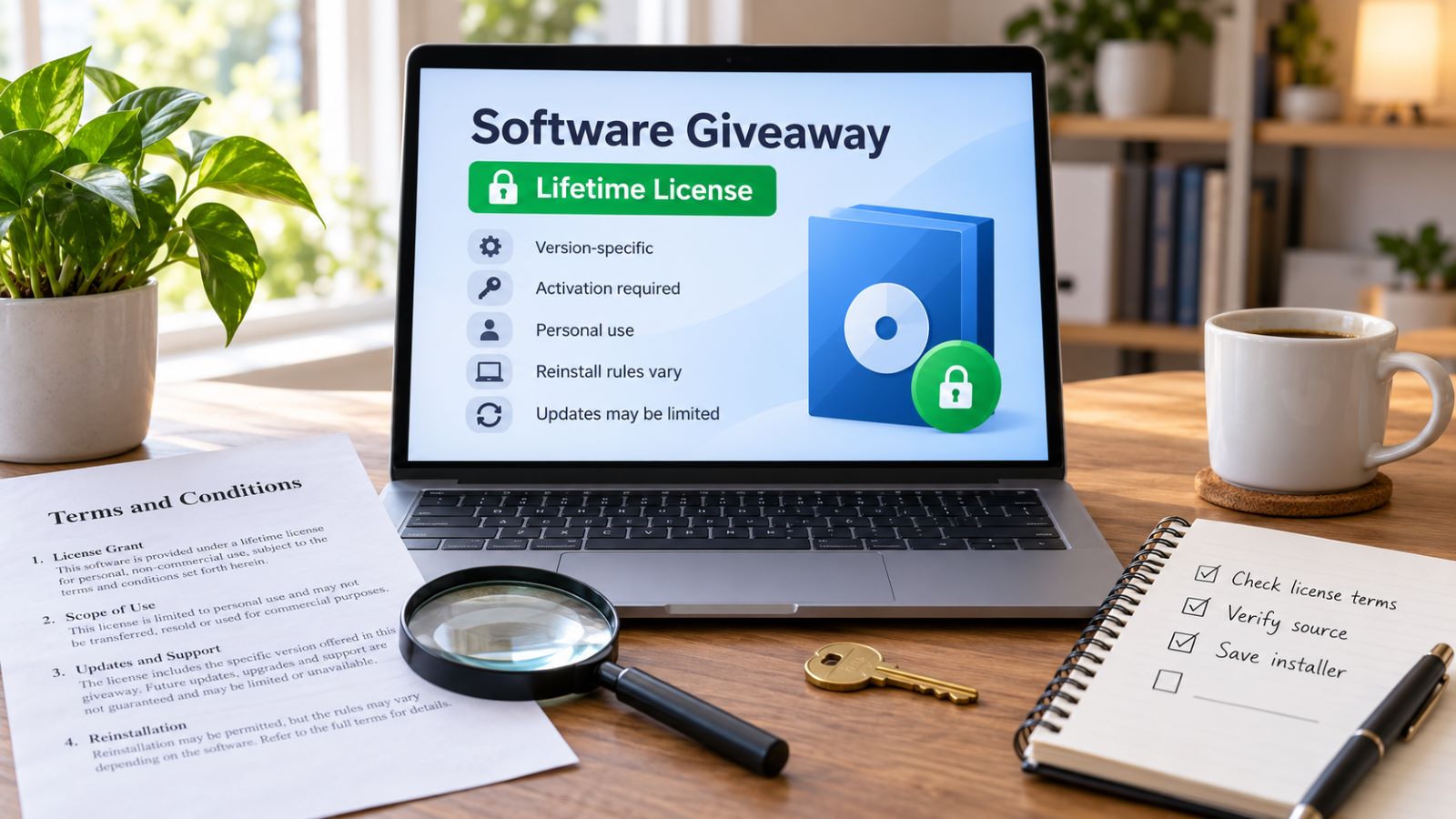
A software giveaway with a lifetime license sounds like a straightforward deal: claim a paid application for free and keep using it indefinitely. Yet “lifetime” often describes how long a particular version remains licensed, not how long the developer will provide updates, technical support, or new features. Reinstallation and commercial-use rights may also follow separate rules.
Those differences become important when you replace your computer, upgrade Windows, or discover that a newer version requires payment. Before claiming a free lifetime software license, establish what remains available after the promotion ends and whether those conditions fit the way you intend to use the application.
What Does a Lifetime Software Giveaway License Actually Cover?
The terms lifetime license and perpetual software license are often used interchangeably, although neither explains every condition of an agreement. Perpetual generally means the right to use software has no fixed expiration date, subject to the license terms. Lifetime can carry a similar meaning, but promotional offers sometimes use it to describe the licensed edition or a product’s supported lifetime.
Consider a giveaway that unlocks all the features of version 4.2. The license might let you keep using that release without further payment while excluding version 5.0. Another promotion could include updates for twelve months, even though the application remains licensed afterward. Neither arrangement necessarily conflicts with the promise of lifetime use.
The giveaway deadline is independent of the license duration. An offer may close after seven days without affecting software that was properly activated during the campaign.
| License Type | How Long You Can Use It | Update Rights |
|---|---|---|
| Lifetime or perpetual license | No fixed expiration for the licensed edition, subject to its terms | Depend on the agreement |
| Lifetime license with version-limited updates | No fixed expiration for the licensed edition | Updates within a specified major version |
| Fixed-term license | Until the stated expiration date | Depend on the agreement |
| Subscription | While the subscription remains active | Usually included during the subscription |
Two licenses can unlock identical features yet offer different long-term benefits. A promotional edition may exclude technical support, upgrades, or additional installations included with a retail purchase. Understanding software giveaway license terms matters even when the advertised application is a free full version.
Does a Lifetime Software License Include Free Updates?
Not automatically. The right to keep using software and the right to receive future versions are different benefits. Developers may provide only the original build, include maintenance releases, or allow major upgrades under the same license.
Lifetime License Without Free Updates
Vovsoft’s September 2026 OCR Reader giveaway illustrates a restricted lifetime license. The promotion offered perpetual use of OCR Reader 4.2 but excluded free updates. Its conditions also warned that updating the giveaway edition could leave the software unregistered.
The same page advertised a paid Full Edition with a lifetime license and future updates included. Both were described as lifetime products, but their upgrade rights were substantially different.
For someone satisfied with the promotional version, this arrangement may be entirely reasonable. Problems arise when an update replaces a registered build or a future Windows release requires compatibility changes unavailable to giveaway users.
Lifetime License With Minor Updates
A third-party ON1 Effects 2025 giveaway listing advertised a lifetime license with free minor updates. Unlike Vovsoft’s restricted giveaway, this offer was not limited to the original installation build.
That flexibility does not necessarily extend to major upgrades. Maintenance releases for the 2025 edition are different from receiving a new 2026 or 2027 edition. The listing describes a historical offer, not a currently available free license.
Lifetime use and lifetime upgrades are not interchangeable. Before installing a newer release, check whether it is covered by your license and whether the previous version can be restored if registration fails.
Can You Reinstall Software With a Free Lifetime License?
A perpetual right to use an application does not guarantee that every future installation will activate successfully. Some giveaways provide registration keys that remain valid after reinstalling Windows. Others depend on campaign-specific packages or activation services that stop accepting new registrations once the offer closes.
Imagine installing a program with a lifetime license and then replacing your computer two years later. Your original right to use the software may still have no expiration date, but the activation service could refuse another registration. Saving the installer and key helps preserve important information without guaranteeing a successful transfer.
Before claiming an offer, look for conditions covering hardware changes, installation limits, license transfers, and replacement devices. When the terms are unclear, contact the publisher while the promotion remains active. Similar issues arise with Giveaway of the Day activation, where downloading a promotional installer does not always preserve the opportunity to register it later.
Keep your registration email, product version, original installer source, and license conditions together. They may help resolve a future problem, although retaining these records cannot override activation restrictions.
Can a Lifetime Software License Stop Working?
Yes. A lifetime license may remain valid while the application becomes difficult or impossible to use. Licensing rights and technical availability are separate matters, particularly when software depends on external services.
An offline image converter might continue working for years on a compatible computer. A program that relies on cloud processing, online authentication, or third-party APIs has more dependencies. If an essential service closes, some functions may disappear even though the original license has not expired.
Operating system changes present another challenge. Older applications sometimes depend on drivers, libraries, or security components that newer Windows versions no longer support. A developer may release a compatible edition, but your giveaway license might not include it.
These limitations do not mean perpetual licenses are inherently unreliable. They mean the agreement cannot guarantee compatibility with technology that does not yet exist. For software tied to online services or frequent system updates, continued maintenance deserves particular attention.
What Should You Check Before Claiming a Lifetime Giveaway?
The words “Lifetime License” on a promotional page are not enough to determine its value. Before accepting an offer, review the conditions that will affect how you use the software months or years later.
Six details are especially important:
- Licensed edition. Confirm the publisher, product name, and version. A free lifetime key may apply to a special promotional build rather than the standard retail release.
- License duration. Establish whether the right to use the application is perpetual or expires after a specified period. Keep the claim and activation deadlines separate.
- Update rights. Check whether maintenance releases, major upgrades, or no future updates are included.
- Reinstallation and transfers. Determine whether the software can be activated after replacing a computer, changing hardware, or reinstalling Windows.
- Commercial permissions. Verify whether the giveaway permits business use and how those rights differ from the retail edition.
- Technical support. Find out whether assistance is included, limited to a specific period, or unavailable to promotional users.
Read the individual offer alongside the developer’s published conditions. SharewareOnSale’s terms and conditions, for example, explain that licensing, updates, support, and compatibility vary by product.
When essential details are missing, do not interpret silence as permission. A free lifetime license can still be useful without upgrades or support, but uncertainty around its restrictions makes long-term planning difficult.
When Is a Lifetime Giveaway Better Than a Paid License?
A lifetime giveaway can be a good choice when the current version already does everything you need. A lightweight offline utility may remain useful for years without significant changes, making paid upgrades unnecessary. If the licensing terms permit your intended use and reactivation is not a major concern, the promotional edition may offer genuine value.
The calculation changes with software that needs ongoing maintenance. Backup applications, security products, and tools connected to online services often depend on compatibility updates and reliable support. Paying for broader licensing rights can be worthwhile when an unexpected failure would interrupt important work.
There is also little value in obtaining a lifetime key for software you have no reason to use. The regular retail price is not a measure of usefulness, and collecting unused applications creates more maintenance than savings.
Choose a giveaway when its limitations fit your needs. A worthwhile lifetime license should provide lasting access to software you actually use, under conditions you understand before accepting the offer.