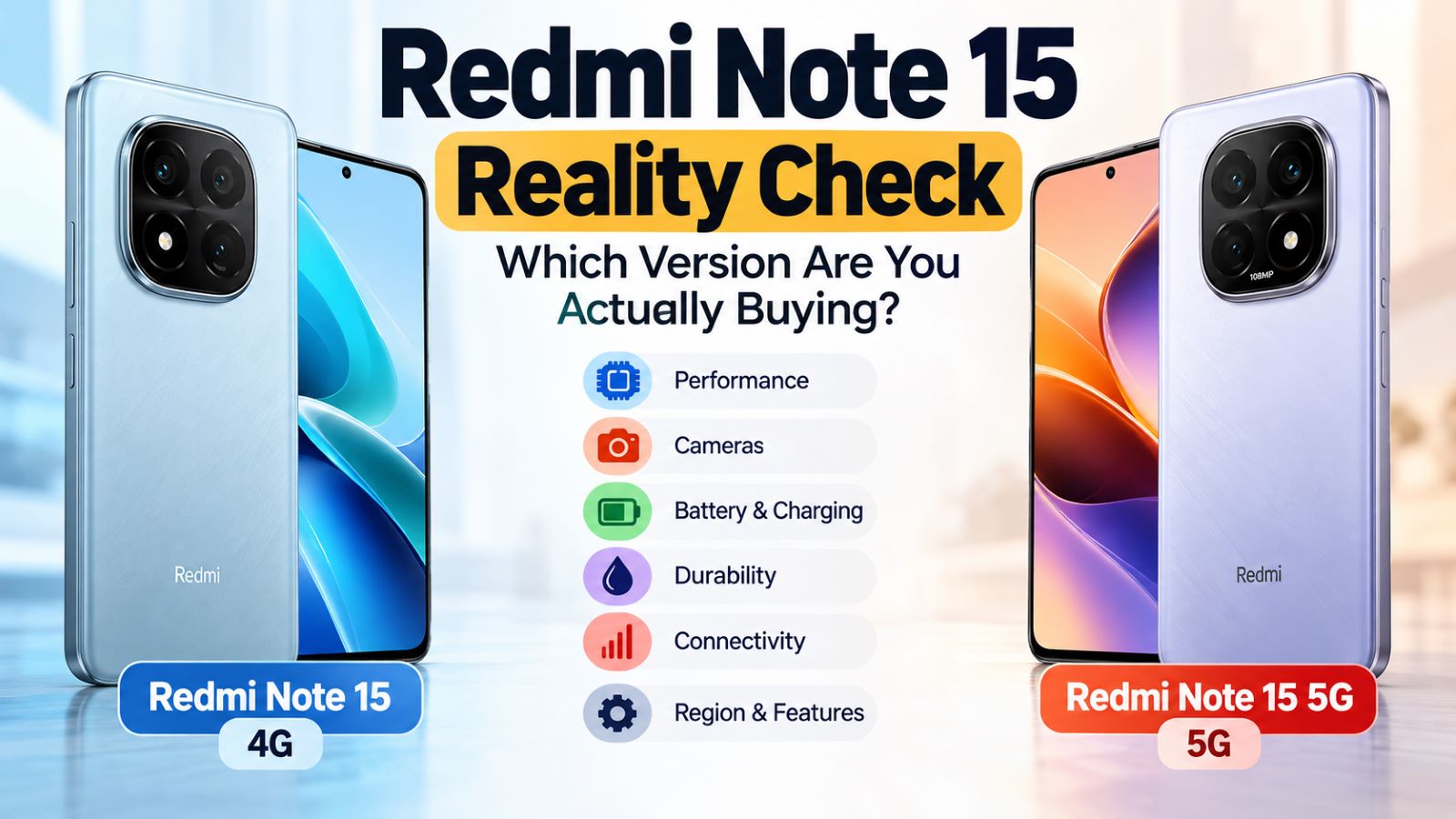
Redmi Note 15 is no longer a rumor or an unreleased name appearing in questionable listings. The more useful question in 2026 is which Redmi Note 15 a seller actually means, because Xiaomi sells a standard model alongside a separate Redmi Note 15 5G, and the differences go well beyond mobile-network support.
The different Redmi Note 15 models share the same family name and much of the same design language, but their processors, cameras, batteries, charging, and connectivity are not identical. The standard version uses a MediaTek Helio G100-Ultra, carries a larger 6,000mAh battery, and charges at 33W. The 5G version moves to a Snapdragon 6 Gen 3, adds OIS and an ultrawide camera, improves water resistance, and supports 45W charging. Exact model identification therefore matters more than comparing two listings that both happen to say “Redmi Note 15.”
Quick Reality Check: Standard or 5G?
The standard and 5G versions are separate products rather than one phone sold with an optional modem. Retailers may also describe the standard phone informally as Redmi Note 15 4G, so 4G vs 5G searches usually refer to this same basic comparison.
For most buyers, the split is straightforward. The standard phone favors battery capacity and is usually positioned below the 5G model in price, while the 5G version has the stronger processor, faster charging, better protection against water, and the more versatile rear-camera setup. That does not automatically make the 5G version the smarter purchase, because those upgrades matter differently depending on how the phone will be used. Someone focused on messaging, video, navigation, and battery capacity may see less value in paying extra than a buyer who games or plans to keep the device for several years.
The naming can still cause confusion because stores may shorten titles, omit “5G,” emphasize storage instead of the exact model, or mix regional specifications into one product page. A low price can also look unusually attractive simply because the listing refers to the standard phone rather than the more expensive 5G version. Confirming the exact variant before comparing prices avoids that mistake.
Redmi Note 15 vs Redmi Note 15 5G Specs
The two phones look closely related, but several specifications change enough to affect the buying decision. The differences cover performance, cameras, charging, durability, and connectivity rather than just the type of mobile network. Display size and refresh rate remain among the areas where the two versions stay much closer.
| Feature | Standard Model | 5G Model |
|---|---|---|
| Mobile network | 4G | 5G |
| Chipset | MediaTek Helio G100-Ultra | Snapdragon 6 Gen 3 |
| Display | 6.77-inch FHD+ AMOLED, 120Hz | 6.77-inch FHD+ AMOLED, 120Hz |
| Main camera | 108MP | 108MP with OIS |
| Secondary rear camera | 2MP depth | 8MP ultrawide |
| Battery | 6,000mAh | 5,520mAh |
| Charging | 33W | 45W |
| Reverse charging | Up to 18W | Up to 18W |
| Water resistance | IP64 | IP66 |
| Thickness | 7.94mm | 7.35mm on Black and Glacier Blue |
| Weight | 183.7g | 178g |
| Security updates | 6 years | 6 years |
| NFC | Market-dependent | Market-dependent |
The standard model combines a larger battery with a slightly thicker and heavier body. Its official Redmi Note 15 specifications also confirm the Helio G100-Ultra chipset, 33W charging, IP64 rating, and 4G network support. The 5G model takes the opposite approach by cutting some weight while moving to stronger hardware and IP66 protection. That makes the physical and performance differences more meaningful than the shared product name initially suggests.
The camera row is another place where the headline numbers hide useful detail. Both versions lead with 108MP, yet the standard phone pairs that sensor with a 2MP depth camera while the 5G model adds OIS and an 8MP ultrawide. A buyer comparing only megapixels could easily miss the more important difference in camera flexibility.
4G vs 5G: More Than Just Connectivity
It would be easy to assume that the main difference is whether the phone connects to a 5G network. In practice, Xiaomi changed enough hardware that the 5G model behaves more like a higher specification tier than a simple radio upgrade. That distinction affects performance, photography, durability, charging, and even how the phone feels in the hand.
The Snapdragon 6 Gen 3 gives the 5G version more performance headroom, especially for heavier apps and games. Its camera gains OIS and an ultrawide lens, the body gets a stronger IP rating, and charging rises from 33W to 45W. The standard model counters with a larger battery and a simpler hardware package that may cost less. For someone who mainly uses social apps, video, messaging, and navigation, that trade-off can still make sense.
A cheap standard model is therefore not necessarily a discounted 5G version. If the listing omits the network type, it may be hiding several other hardware differences at the same time.
Is the 5G Version Actually Faster?
The chipset change is substantial enough to matter beyond branding. The standard model uses the Helio G100-Ultra, while the 5G version moves to Qualcomm’s Snapdragon 6 Gen 3. That gives the latter more CPU and graphics headroom before benchmark numbers even enter the discussion.
In independent performance testing, the 5G model scored about 43% higher in AnTuTu 11. Geekbench 6 showed roughly 42% higher single-core and 74% higher multi-core results. Those figures do not mean every application will open 42% or 74% faster. They do show that the difference between the two chipsets is substantial rather than cosmetic.
For messaging, browsing, streaming, maps, social media, and ordinary photography, the standard model should still cover everyday workloads comfortably. The faster hardware becomes more relevant with demanding games, heavier multitasking, or several years of future software updates. Buyers planning a longer ownership cycle therefore have a stronger reason to choose the 5G version than someone replacing the phone after a couple of years.
Which Version Has the Better Battery Setup?
Battery creates an interesting trade-off because the larger number does not automatically identify the better overall package. The standard model has a 6,000mAh battery with 33W charging, while the 5G version uses a smaller 5,520mAh battery but raises charging speed to 45W. That gives the standard phone an advantage in raw capacity, while the 5G model answers with faster recovery when the battery runs low. The two versions therefore prioritize different parts of the same problem.
A larger battery can be useful for someone who spends long periods away from a charger, although real endurance also depends on the chipset, modem, screen behavior, and software. Capacity alone cannot predict exactly how many extra hours the standard model will last in a particular workload.
The 5G version takes a different approach by combining faster charging with a slimmer and lighter body. That trade can be more convenient for someone who has frequent access to short charging sessions during the day. Choosing between them is therefore more nuanced than simply treating 6,000mAh as automatically better than 5,520mAh.
Does the 5G Version Have the Better Camera?
Both models advertise a 108MP main camera, which can make their camera systems look more similar than they really are. The standard version combines that sensor with a 2MP depth camera, while the 5G model adds optical image stabilization and an 8MP ultrawide. Those changes affect what the camera can do rather than simply increasing a megapixel number.
OIS can help compensate for small hand movements, particularly in lower light or when shutter speeds become slower. The Redmi Note 15 5G specifications also include an 8MP ultrawide and 4K rear-camera video. An ultrawide adds a genuinely different field of view for groups, buildings, landscapes, and cramped interiors. That makes the 5G camera system more versatile even before image-processing differences are considered.
Not every photo from the 5G model will automatically look better, because lighting, autofocus, processing, and camera tuning still matter. The practical point is that these are not identical rear-camera systems simply because both lead with the same 108MP number.
What Changes in Display, Design and Durability?
The displays stay relatively close. Both phones use a 6.77-inch FHD+ AMOLED panel with a refresh rate up to 120Hz, so the 5G model does not move into a completely different screen class.
The physical differences are easier to quantify. The standard phone weighs 183.7g and measures 7.94mm thick, while the 5G version is listed at 178g and about 7.35mm for Black and Glacier Blue. The difference is not huge on paper, but a few grams and fractions of a millimeter are noticeable more often than a benchmark score because they affect every pickup, pocket, and long reading session. The 5G model also combines that slimmer construction with the stronger IP66 rating.
IP64 on the standard phone still provides useful resistance to dust and splashes. IP66 gives the other version more protection on paper, which can matter over years of weather exposure and ordinary accidents. Neither rating turns the device into something that should be deliberately submerged, but the 5G model has the stronger durability specification.
Why Region and Model Number Still Matter
Identifying the phone as the standard or 5G version is only the first step. Configurations can vary by market, including NFC, RAM, storage, colors, network support, warranty coverage, and sometimes package contents. A specification seen in one country’s review is therefore not automatically guaranteed on every unit worldwide.
Two legitimate listings can differ without either one being fake. Problems start when a seller presents one regional configuration as though it represents every version sold worldwide.
NFC, Networks and Regional Features
NFC is a good example because availability can vary by market. Seeing contactless payments demonstrated in one review does not automatically prove that every regional unit includes the same hardware or feature support. Network bands can vary as well, particularly when a phone is imported from another market. A genuine device can therefore be perfectly functional yet still be a poor match for the buyer’s carrier.
That becomes more important when local networks depend on particular LTE or 5G bands for coverage. VoLTE, Wi-Fi calling, and carrier-specific features may also behave differently on imported firmware or hardware combinations. A vague “global version” label is less useful than an exact model number and a confirmed band list.
Storage, Warranty and Box Contents
RAM and storage combinations can change between countries, so a configuration available in one region may never officially appear in another. Retailers can also import memory variants that local Xiaomi channels do not sell. That does not make the phone illegitimate, but it changes what warranty and support the buyer should expect.
Charger inclusion, colors, promotional bundles, and warranty terms may vary as well. A local unit can include different accessories from an imported one even when both are genuine. Seller warranty and manufacturer warranty are not always interchangeable, especially with cross-border purchases. Comparing the exact units available to you is therefore more reliable than matching a retailer page against a review of a different regional SKU.
Do Not Confuse the Standard Model With Pro Versions
Redmi Note 15 sits inside a wider product family. The standard model, the 5G version, Pro variants, and Pro+ are separate devices rather than storage tiers of the same phone. Their processors, cameras, batteries, and prices can differ significantly.
Retailer titles and search snippets sometimes shorten those longer product names. Once “Pro” or “Pro+” disappears from a heading, specifications and prices from different models can easily become mixed into what looks like one comparison. A 200MP camera claim or a much faster charging specification, for example, may belong to another member of the family rather than the standard phone being advertised. That kind of mismatch is a reason to check the exact model before treating a specification as relevant.
The Pro models deserve their own comparison rather than being folded into the standard 4G-versus-5G decision. Once “Pro” or “Pro+” appears in the model name, treat the listing as a different product and verify its hardware separately.
What Should You Verify Before Buying?
A good product listing should make the exact version easy to identify. The chipset, battery, storage, region, and network type should not require guesswork. If the buyer has to infer the model from promotional renders or a vague title, the purchase already carries more uncertainty than it should.
- Whether the listing identifies the standard or 5G version.
- The RAM and storage configuration.
- The intended market or region.
- NFC availability if contactless payments matter to you.
- Supported network bands when importing.
- Local warranty coverage.
- Whether the phone is new, open-box, refurbished, or previously activated.
- Whether the chipset, battery, charging, cameras, and IP rating match the claimed version.
The chipset and battery are particularly useful clues. A listing described as Redmi Note 15 5G but showing a Helio G100-Ultra, 6,000mAh battery, and 33W charging is mixing specifications from the standard model. Snapdragon 6 Gen 3, 5,520mAh, 45W charging, OIS, and IP66 instead point toward the 5G version.
Which Version Makes More Sense?
The two phones suit different priorities rather than forming a simple good-versus-bad hierarchy. Price matters, but so do battery capacity, charging speed, camera flexibility, network support, and how long the buyer expects to keep the device. Matching those priorities first makes the specification table much easier to interpret.
| Your Priority | Better Fit | Why |
|---|---|---|
| Lower purchase price | Standard model | Often the less expensive entry model |
| 5G connectivity | 5G model | Supports 5G networks |
| Stronger performance | 5G model | Snapdragon 6 Gen 3 |
| Largest battery capacity | Standard model | 6,000mAh |
| Faster charging | 5G model | 45W instead of 33W |
| More versatile rear cameras | 5G model | OIS plus 8MP ultrawide |
| Slimmer and lighter body | 5G model | 178g and about 7.35mm |
| Stronger water resistance | 5G model | IP66 instead of IP64 |
| Everyday basics at lower cost | Standard model | Strong display, camera and battery fundamentals |
| Longer-term performance headroom | 5G model | Faster chipset provides more margin |
The standard model has a clear role when price, battery size, and ordinary daily use matter most. Its 120Hz AMOLED display, 108MP main camera, and 6,000mAh battery cover the features many buyers notice every day. Someone who rarely plays demanding games or needs 5G may not gain much from paying a large premium. A strong discount can therefore make the simpler version the more rational purchase.
The 5G version makes its case through accumulation rather than one dramatic upgrade. Stronger performance, faster charging, better water resistance, OIS, an ultrawide camera, and a slimmer body all add value in different situations. Buyers who expect longer ownership or heavier use have more reasons to pay for that broader package.
Final Verdict: Standard or 5G?
The biggest Redmi Note 15 buying mistake in 2026 is no longer believing an early rumor. It is assuming that every product carrying the Note 15 name has the same hardware.
The standard and 5G versions share a family identity and several headline features, but their processors, batteries, charging speeds, cameras, body specifications, and IP ratings differ enough to change their value. Regional variations add another layer because NFC, memory configurations, network compatibility, and warranty conditions can change by market. That means the best deal cannot be identified from the product name and price alone. Exact variant, region, and configuration need to be part of the comparison.
Choose the standard version when lower cost and the larger battery matter more than 5G, OIS, or extra performance. Choose the 5G version when stronger hardware, faster charging, better durability, and the more versatile camera system justify the higher price. Once the exact model is confirmed, the decision is much simpler than the naming makes it appear.