Samsung A57 vs A56 is no longer a comparison between an available phone and a rumored successor. The Galaxy A57 is on sale, so the useful question is whether its improvements are large enough to justify choosing it over a discounted Galaxy A56.
Samsung improved the A57 in several areas without changing the basic Galaxy A formula. The newer model is more refined, while the A56 keeps enough of the same core hardware to remain competitive when discounted.
Samsung A57 vs A56 Quick Verdict
The Galaxy A57 is the better phone overall. Its strongest advantages are the lighter body, IP68 protection, stronger graphics performance, better overall battery endurance, newer software, and the later end of its support window.
In a Galaxy A57 vs Galaxy A56 comparison, however, the newer model does not win every category by enough to justify any price premium. The A56 still makes sense when it is substantially cheaper because its display, camera specification, 5,000mAh battery, 45W charging, and everyday performance remain close. The differences become easier to notice when gaming, keeping the phone for many years, or simply carrying a large 6.7-inch device all day.
For messaging, browsing, maps, photos, video, and social apps, either phone already covers the basic job comfortably. Someone upgrading from an older mid-range device may therefore care more about current price and storage capacity than about the generational gap between these two models.
Samsung A57 vs A56 Specs Compared
Comparing the Samsung Galaxy A57 and A56 side by side shows why the newer phone is more of a refinement than a complete redesign. The meaningful changes concentrate around the body, chipset, water resistance, efficiency, and software generation, while several core specifications remain familiar.
| Feature | Galaxy A57 | Galaxy A56 |
|---|---|---|
| Display | 6.7-inch FHD+ 120Hz AMOLED | 6.7-inch FHD+ 120Hz AMOLED |
| Chipset | Exynos 1680 | Exynos 1580 |
| Main camera | 50MP with OIS | 50MP with OIS |
| Ultrawide | 12MP | 12MP |
| Macro | 5MP | 5MP |
| Front camera | 12MP | 12MP |
| Battery | 5,000mAh | 5,000mAh |
| Charging | 45W wired | 45W wired |
| Thickness | 6.9mm | 7.4mm |
| Weight | 179g | 198g |
| Water resistance | IP68 | IP67 |
| Launch software | Android 16 / One UI 8.5 | Android 15 / One UI 7 |
| OS upgrades | Up to 6 generations | Up to 6 generations |
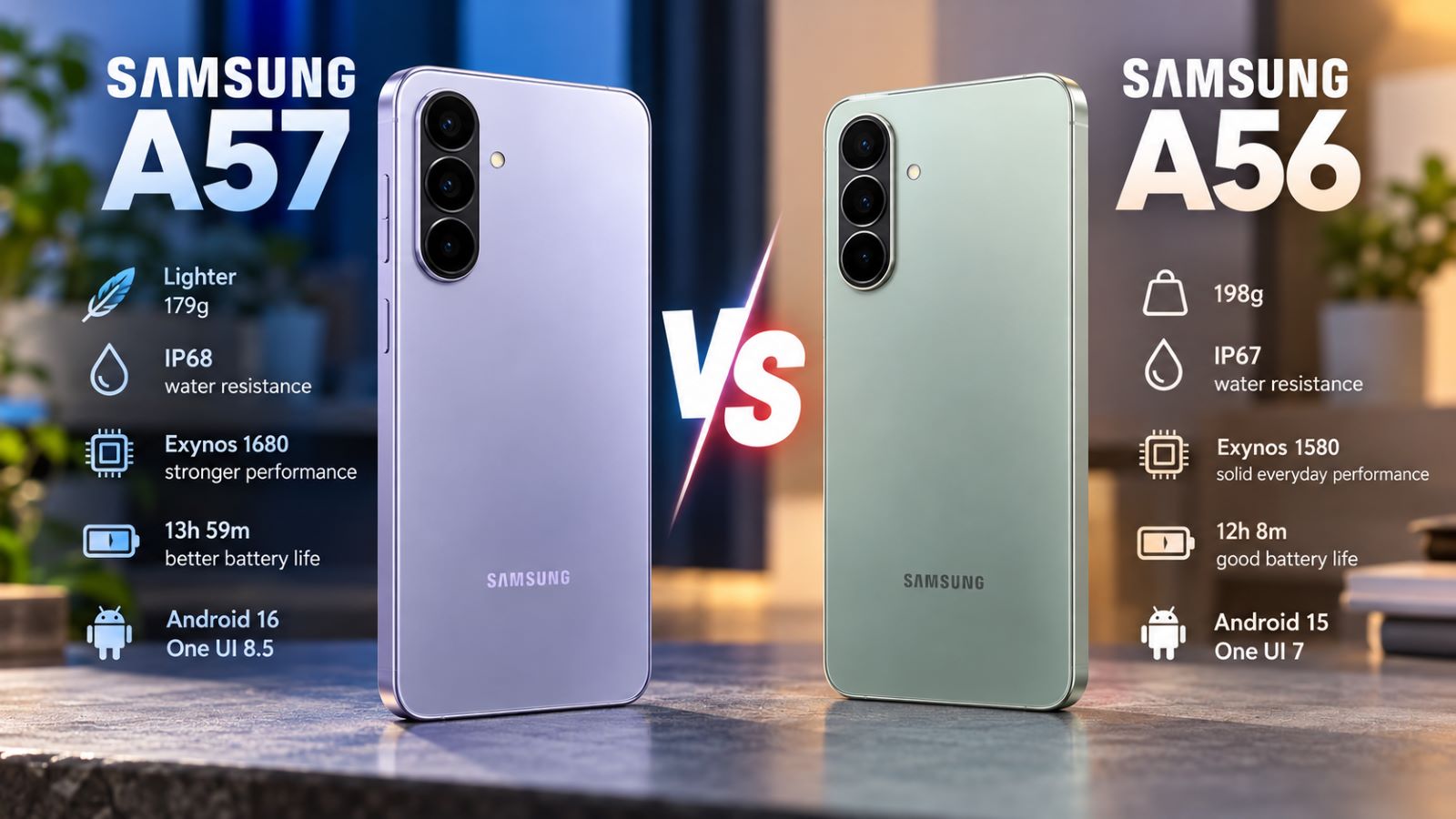
The A57 weighs 179g and measures 6.9mm thick, compared with 198g and 7.4mm for the A56. Both use a 5,000mAh battery and support 45W wired charging, while the newer model moves from IP67 to IP68 water resistance. Those changes, along with the newer processor and software generation, are reflected in the official Galaxy A57 launch details.
The table also shows where Samsung resisted changing things for the sake of a new model number. Camera resolutions, battery capacity, charging, and overall display format remain close, so buyers are not paying for a completely new hardware formula.
Does the Galaxy A57 Feel Better in the Hand?
This is one of the upgrades you can notice without opening an app. A 19g reduction is meaningful on a 6.7-inch phone, and the A57 also trims half a millimeter from the body. Together, those changes make the newer model less bulky during long reading sessions, navigation, video, or one-handed use.
Durability improves as well. IP67 already gives the A56 useful protection against dust and water, while IP68 gives the A57 the stronger official rating. Neither rating means the phone should be treated as an underwater device, but the newer model has more headroom against accidental exposure.
Design alone is unlikely to justify replacing a perfectly good A56. For someone buying either model today, though, lower weight, slimmer construction, and IP68 are advantages that can be noticed repeatedly rather than only when running a benchmark or reading a specification sheet.
Performance and Everyday Speed
The Galaxy A57 moves from the Exynos 1580 to the Exynos 1680. That is a genuine performance upgrade, although its value depends heavily on what the phone is doing. Routine use does not expose the full difference because both devices are already quick enough for messages, browsing, banking, maps, streaming, and normal multitasking.
Graphics-heavy workloads give the newer chipset more room to separate itself. That makes performance one of the areas where the answer changes depending on whether the phone is mainly a communication device or also a portable gaming machine.
CPU and Everyday Performance
The A57 reached 4,411 in Geekbench 6 versus 3,899 for the A56 in direct performance testing, putting the newer model roughly 13% ahead in that benchmark.
That extra performance gives the A57 more headroom for future software and heavier workloads, but it does not make the A56 slow. Most everyday apps already run comfortably on the older chipset, and a benchmark advantage should not be translated directly into how quickly every screen or application will feel.
For a buyer who mainly uses messaging, navigation, browser tabs, streaming, and banking apps, a meaningful discount or a larger storage configuration can still outweigh the CPU advantage. The A57 becomes more compelling when the phone is expected to remain in service for years and workloads have time to grow around it.
Gaming and GPU Performance
Gaming creates a wider separation. The A57 scored 1,742 in 3DMark Wild Life Extreme versus 1,332 for the A56, a difference of roughly 31% in this graphics-focused test.
Real games will not reproduce that exact percentage in every situation, yet the result shows where the Exynos 1680 upgrade has more practical value. Demanding titles, higher graphics settings, and future games all give the newer GPU more opportunity to matter.
Casual games, streaming, and social apps barely use that advantage. For those workloads, the A56 remains perfectly capable, while someone who treats the phone as a gaming device has a much stronger reason to pay for the A57.
Is the Galaxy A57 Display Actually Better?
Both phones use a 6.7-inch FHD+ AMOLED display with a refresh rate up to 120Hz, so the basic viewing experience remains closely related rather than fundamentally different. Brightness testing gives the A57 a modest advantage, but both screens already perform at a level that suits a modern mid-range phone.
That difference can help outdoors without turning the A56 panel into a weakness. Scrolling, video, photos, and normal app use remain smooth on both models, and neither phone offers the kind of display change that transforms how the device feels from one generation to the next.
The screen therefore strengthens the overall A57 package without becoming a compelling reason to upgrade on its own. Someone who already likes the A56 display is unlikely to see the newer panel as the feature that makes an A57 purchase worthwhile.
Battery Life and Charging Compared
Both phones carry a 5,000mAh battery and support 45W wired charging. Samsung did not increase the headline capacity or charging rate, so the interesting part of this comparison is how efficiently each phone uses essentially the same battery specification.
The A57 reached 13 hours 59 minutes in the same Active Use testing where the A56 reached 12 hours 8 minutes. That is a useful endurance gain without adding battery size or making the body heavier. For long days away from a charger, the efficiency improvement has more practical value than the unchanged 5,000mAh number suggests.
Charging tells a different story because both models top out at 45W wired. A buyer focused on battery endurance has a reason to lean toward the A57, whereas someone mainly concerned with refill speed gains little by choosing one over the other.
Is the Galaxy A57 Camera Actually Better?
The camera specifications make this comparison look more familiar than new. Both phones use a 50MP main camera with OIS, a 12MP ultrawide, a 5MP macro camera, and a 12MP front camera. Samsung therefore did not use the A57 generation to introduce a completely different rear camera system.
Any improvement has to come more from image processing, autofocus behavior, low-light tuning, and the newer software stack than from dramatically different hardware numbers. That can still affect real photos, particularly in difficult light or with moving subjects, but it is a subtler change than replacing the sensor or adding a new telephoto camera.
For daylight photos, social-media shots, and ordinary video, the A56 remains competitive. The A57 may produce the more polished result in some situations, yet the camera is a relatively weak reason to pay a large premium compared with lower weight, battery endurance, or graphics performance.
Megapixel counts are not very informative here because the headline figures are essentially the same. Actual sample photos, shutter behavior, autofocus consistency, and low-light results tell more about the difference than another row of camera specifications.
Software, AI Features and Update Support
Software creates a more durable separation because the A57 begins one generation later. It launched with Android 16 and One UI 8.5, while the A56 entered the market with Android 15 and One UI 7.
Both devices receive unusually long support for their class. The Galaxy A56 support policy covers up to six generations of Android and One UI upgrades plus six years of security updates, and the A57 follows the same long-term approach. The policy itself is therefore not the major difference; the newer starting point is.
What Changes in One UI and AI Features?
The A56 already includes Samsung’s Awesome Intelligence tools, so this is not a simple case of the A57 having AI while the older phone does not. Circle to Search and Samsung’s photo-editing features were already part of the previous generation.
The A57 starts from newer software and builds updated AI and editing capabilities around that platform. Feature availability can still vary by market, language, application, and software release, while some individual tools may reach older models through updates. That makes long-term software position more useful to compare than the number of AI-branded functions listed at launch.
For most buyers, starting one Android generation later is the clearer advantage. Individual AI tools may change several times during the life of the phone, whereas the underlying software timeline remains relevant until support finally ends.
Which Phone Gets Updates for Longer?
The nominal support policy is similar on both phones, but the A57 enters that cycle a year later. Its newer launch software and later release therefore push the end of the original support window further into the future.
That matters for someone who expects to keep a phone for five or six years. Over a shorter two- or three-year ownership period, the difference is much less likely to affect day-to-day use and should carry less weight in the purchase decision.
Long ownership also magnifies some of the A57’s other advantages. Extra graphics headroom and a newer chipset matter more when the same hardware has to handle apps several years from now than when the buyer plans to replace it relatively quickly.
How Much More Is the Galaxy A57 Worth?
Price is where the Samsung A57 vs A56 comparison becomes less universal. The A57 is clearly the more complete phone, but the older model can become much more attractive once retailer discounts create a meaningful street-price gap.
A small difference favors the A57 because several improvements arrive together: lower weight, IP68, stronger graphics, better overall battery endurance, newer software, and a later support horizon. A large difference changes the calculation because the A56 retains the same battery capacity and charging rate, very similar camera specifications, a strong 120Hz AMOLED display, and performance that remains entirely adequate for normal use.
Storage can complicate the decision further. A discounted 256GB A56 may be more useful than a significantly more expensive 128GB A57 for someone who keeps a large collection of photos, videos, games, or offline media. Paying for the newer model while stepping down in storage is not automatically the better trade.
For that reason, current configuration and street price matter more than launch MSRP. Retail discounts can change which phone represents better value without changing a single specification.
Which Galaxy Should You Buy?
The choice becomes clearer when each phone is matched to a specific priority. Some A57 advantages affect everyday ownership, while others matter only for particular workloads.
| Your Priority | Better Choice | Why |
|---|---|---|
| Lowest purchase price | Galaxy A56 | Discounts can make the older model much better value |
| Lighter and slimmer phone | Galaxy A57 | 179g and 6.9mm versus 198g and 7.4mm |
| Water resistance | Galaxy A57 | IP68 instead of IP67 |
| Gaming and graphics | Galaxy A57 | Substantially stronger GPU benchmark result |
| Normal everyday performance | Either | A56 remains fast enough for most routine tasks |
| Display quality | Either | Both provide strong 120Hz AMOLED displays |
| Camera value | Galaxy A56 | Core camera specifications remain very similar |
| Battery endurance | Galaxy A57 | Better overall active-use result |
| Charging speed | Either | Both support 45W wired charging |
| Longest remaining support | Galaxy A57 | Later release and newer launch software |
| Best value at a large discount | Galaxy A56 | Retains most of the core experience |
The A57 wins more individual categories, but those wins do not all have equal value. A lighter chassis can matter every time the phone is picked up, while stronger GPU performance may mean almost nothing to someone who never plays demanding games. Battery endurance sits somewhere in between because almost everyone benefits from it, although not everyone needs the extra margin.
The A56 is therefore not the loser simply because it has fewer wins in the table. Its case becomes stronger as the price gap grows, because each incremental A57 advantage effectively becomes more expensive.
Buyers moving from Apple also have a practical issue beyond the hardware comparison. Transferring data from iPhone to Android can affect how quickly either Galaxy feels ready for normal use after the switch, particularly when photos, messages, contacts, and accounts need to move with you.
Samsung A57 vs A56 Final Verdict
The Galaxy A57 is the easier recommendation when the price difference is modest because its upgrades accumulate across everyday comfort, performance, endurance, and remaining software life. None of those changes completely reinvents the Galaxy A formula, but together they make the newer model more rounded.
The Galaxy A56 remains a strong value option rather than an outdated alternative. Its display is still competitive, camera specifications are close, battery capacity and charging are unchanged, and everyday performance remains more than sufficient for typical use. A substantial discount can easily matter more than an upgrade that is noticeable mainly in weight, gaming, or long-term ownership.
For Samsung A57 vs A56, the practical dividing line is therefore price plus priorities. The A57 makes more sense when its premium is reasonable or when IP68, lighter construction, GPU performance, battery endurance, and the longest remaining support matter. The A56 is the smarter buy when the discount is substantial and those improvements would make little difference to how the phone is actually used.