An AI chatbot can provide an exact date, a journal title, and a convincing explanation while getting the facts wrong. The answer may resemble a researched summary rather than a guess. That gap between fluent language and actual evidence is why AI hallucinations can be difficult to recognize. The mistake is often hidden in a detail the reader has little reason to question.
They aren’t limited to obscure trivia. Hallucinations can appear in document summaries, research assistance, software instructions, and search-based answers. Knowing what causes them helps you spot weaknesses without assuming every response is unreliable.
What Are AI Hallucinations?
AI hallucinations occur when a generative system presents false, unsupported, or fabricated content as reliable information. A chatbot might invent a research paper, misattribute a quotation, or describe a feature that doesn’t exist. The rest of its answer may be accurate, making the invented detail harder to notice.
The term isn’t used identically across technical discussions. Some definitions include broader factual errors and contradictions; others focus on plausible inventions without a factual basis. Rather than applying the label to every bad answer, identify whether the problem involves a source, a factual detail, or a misreading of evidence. Fiction requested for a story is different because it doesn’t claim to report real events.
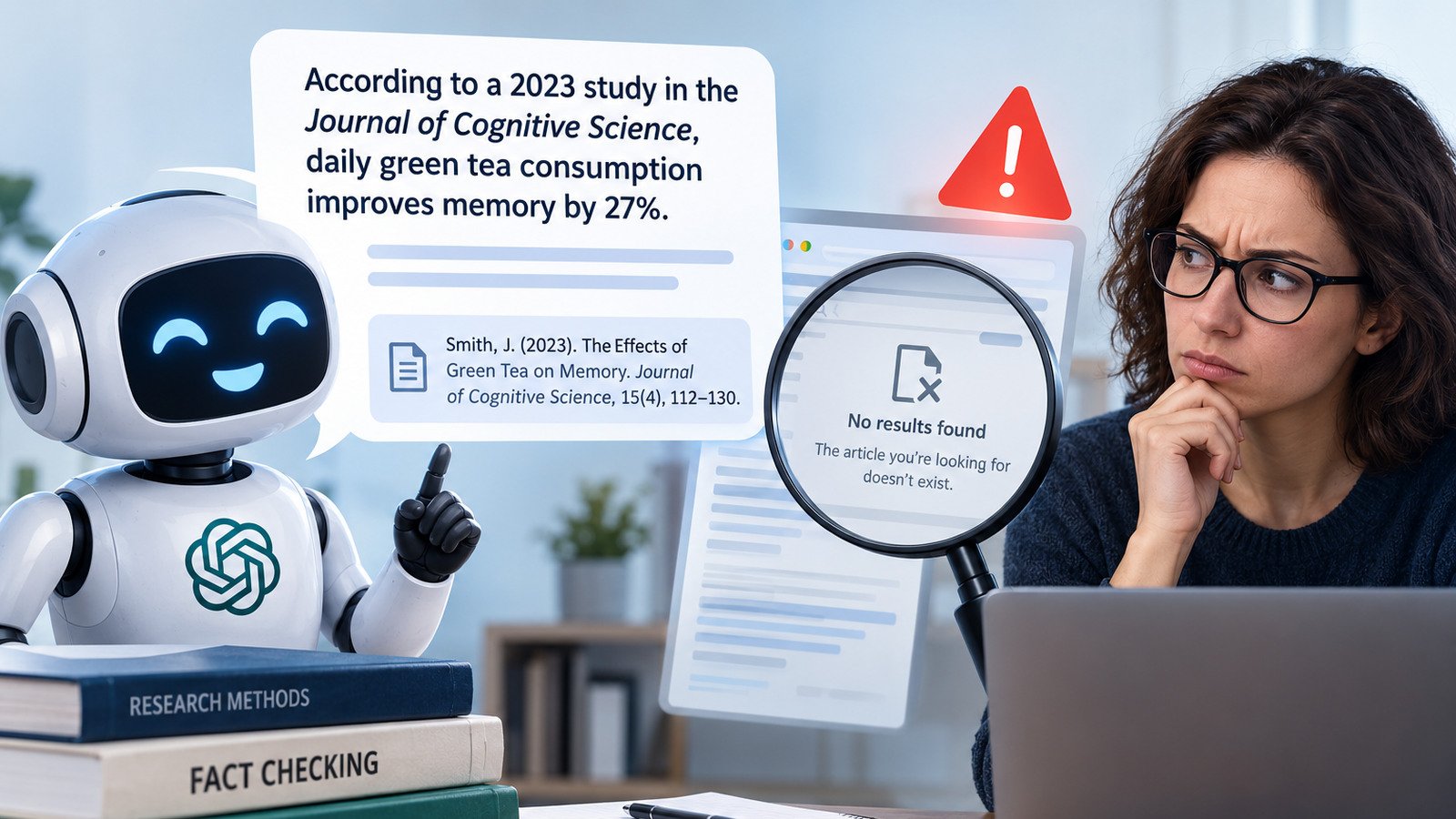
Imagine asking for published research connecting a certain diet to memory improvement. The assistant responds with an article title, named authors, and a journal issue, but the publication cannot be found because it was invented. This hypothetical example illustrates how recognizable academic formatting can make fabricated information look legitimate.
Why Do AI Chatbots Hallucinate?
Large language models generate text from learned patterns and the information available in a conversation. They don’t retrieve a verified database entry for every question. A coherent explanation can therefore contain a detail that the available evidence doesn’t establish. Fluency and factual accuracy are related, but they aren’t the same capability.
Ambiguous names, conflicting records, and missing information can all contribute to errors. A model may combine details from two biographies or transfer a feature from one software version to another. More context reduces some ambiguity, but even a clear question can receive a fabricated answer.
Why Models Sometimes Guess Instead of Saying They Don’t Know
Certain details cannot be inferred reliably from patterns, such as someone’s unpublished date of birth. A model might still produce a date because the question calls for one. That answer can mislead without any deliberate intent to deceive.
OpenAI’s hallucination research highlights another factor: many evaluations reward correct guesses but offer little credit for admitting uncertainty. This can favor systems that attempt an answer over systems that acknowledge missing evidence. The research doesn’t mean every wrong response is caused by evaluation incentives; it helps explain why guessing remains a persistent problem.
Why Wrong Answers Can Sound So Confident
A model can reproduce the style of an academic abstract, software manual, or official notice without verifying every detail. It may supply confident wording and a convincingly formatted citation in the same paragraph. Neither is proof that the document exists or supports the claim. This is why tone alone is a poor test of reliability.
A fabricated detail is especially difficult to spot when surrounded by correct information. An answer might accurately describe existing products while inventing an upcoming release. Familiar facts can lend the unsupported announcement credibility it hasn’t earned.
Types of AI Hallucinations With Examples
Hallucinations become easier to recognize when their different forms are separated. The examples below are hypothetical, not reports of specific chatbot incidents. IBM’s hallucination overview discusses factual, contextual, and consistency-related failures that help explain these distinctions.
| Type | Illustrative AI Answer | What Went Wrong |
|---|---|---|
| Invented reference | “A 2025 Journal of Digital Behavior study proved this effect,” citing a paper that does not exist. | A plausible publication was fabricated. |
| Incorrect factual detail | “The update launched in March,” although the official release notes give September. | A specific date was wrong. |
| Blended context | A policy summary merges requirements from two different states into one nationwide rule. | Real details were put in the wrong jurisdiction. |
| Unsupported document summary | “The contract promises a refund within 14 days,” although the supplied document has no refund clause. | The answer added content missing from the source. |
| Internal contradiction | The model says a feature is unavailable, then recommends turning it on under the same conditions. | The response makes incompatible claims. |
Each example points to a different failure. A fabricated publication may not exist, while an unsupported summary distorts a real document. Contradictory instructions may arise because the model has confused the conditions under which a feature works. Treating those errors as interchangeable can hide what actually needs correcting.
Why AI Search and Citations Can Still Be Wrong
Search tools let chatbots consult information beyond their training data. Retrieval-augmented generation (RAG) likewise brings selected documents into the answering process. Both can reduce unsupported guessing, but finding a page doesn’t guarantee the model understands its limitations.
Imagine an assistant citing official release notes for a software product. The notes say a feature requires an enterprise subscription, but the answer claims it is available on every plan. The document is genuine and relevant; the model has omitted the condition that matters.
Other errors happen before the answer is written. Search might retrieve an older page or a document about a similarly named product. A summary may then combine otherwise accurate details from incompatible sources, making the links appear more reassuring than they are.
A long citation list is not a substitute for evidence that supports the conclusion. Fact-checking AI answers means checking whether each important claim matches the cited material, not simply counting links. Access to sources reduces some risks without eliminating errors in how they’re used.
How to Spot AI Hallucinations
No particular phrase or writing style proves that an answer contains a hallucination. Confident wording can accompany accurate information, and hesitant wording can still conceal errors. The strongest warning signs concern claims that are more specific than the supporting evidence.
A first read may reveal details that deserve closer inspection. None of these signs proves that the whole answer is false, and their absence doesn’t establish accuracy. Give them particular weight when a statement could affect a publication or decision:
- A precise date, quotation, statistic, or version number appears without an identifiable basis.
- A named study, author, court ruling, or document cannot be located under its stated title.
- The response changes its explanation of a feature, rule, or condition from one paragraph to another.
- A document summary includes details you cannot find in the supplied material.
- An answer treats a disputed question as settled without acknowledging relevant conditions.
Be alert when an answer adds details absent from the material you supplied. If meeting notes contain no task owners but the AI summary assigns names to every action, those assignments may be guesses. A convincing layout doesn’t turn those guesses into documented decisions. Before sharing the summary, distinguish recorded assignments from proposed ones.
How to Reduce AI Hallucinations With Better Prompts and Sources
Better prompts can discourage unsupported guessing, but no wording guarantees accuracy. Supply the relevant document, specify the location or software version, and distinguish factual claims from suggestions. Telling the model to act as an infallible expert is less useful than giving it reliable input.
For document-based work, set an explicit boundary around the source material. State what should happen when a document doesn’t contain the requested answer. A reusable instruction is:
Answer using the supplied document only. If the document does not establish a requested fact, identify the missing information instead of guessing. Separate statements supported by the document from your own suggestions.
This wording won’t prevent a model from misreading the source. When writing ChatGPT prompts, specify which statements must come from the source and which can be suggestions. That distinction exposes missing information rather than hiding it inside a plausible answer.
For longer assignments, review the evidence summary before asking for conclusions. That allows you to correct misunderstandings before they become part of a proposal or recommendation. If the model separates documented statements from inferences, you can see which parts need human judgment.
What to Do When AI Makes Up Facts or Sources
When you find a fabricated statement, trace which conclusions depend on it. Replacing an invented study title with a real publication won’t fix an argument built on results the publication never reported. Keep only the parts that remain supported and revise the affected reasoning.
A market analysis might combine genuine sales figures with a fabricated analyst quotation. Removing the quotation is necessary, but the forecast also needs a second look if it relied on that supposed expert’s opinion. Rebuild the argument from identifiable data rather than requesting another authoritative-sounding endorsement.
A targeted correction works better than a vague demand for certainty. Supply the relevant source passage, name the unsupported claim, and ask the assistant to revise only the material affected by that error. Review the revised output because the same misunderstanding can reappear in new wording.
If the mistake has already appeared in a report, email, or presentation, correct it where readers may encounter it. Explain what changed and whether any conclusions are affected. For recurring high-impact errors, introduce independent review before the next version is shared. That is more useful than repeatedly asking the same model to reassure you.
Can AI Hallucinations Ever Be Eliminated?
Model training, retrieval systems, and uncertainty reporting continue to improve. Evaluation methods can also reward a justified ‘I don’t know’ instead of treating every unanswered question as a failure. These changes can reduce certain errors, but they don’t establish that hallucinations can be eliminated.
Some questions have no public answer, while others concern facts that change rapidly. A search-enabled system can still select the wrong document or overlook an exception. Reliability depends on both the evidence available and how the system uses it. A fresh source is not necessarily a relevant one.
The consequences of an error should determine how much review the output receives. Fiction can accommodate invented details; a contract summary or medication instruction cannot. Where mistakes matter, treat an AI response as material to inspect rather than an authority to obey.
Hallucinations don’t make generative AI useless. It can still explain concepts, organize information, and produce working drafts. The challenge is deciding which claims deserve trust and which require evidence beyond the generated answer. Convincing language alone cannot settle that question.