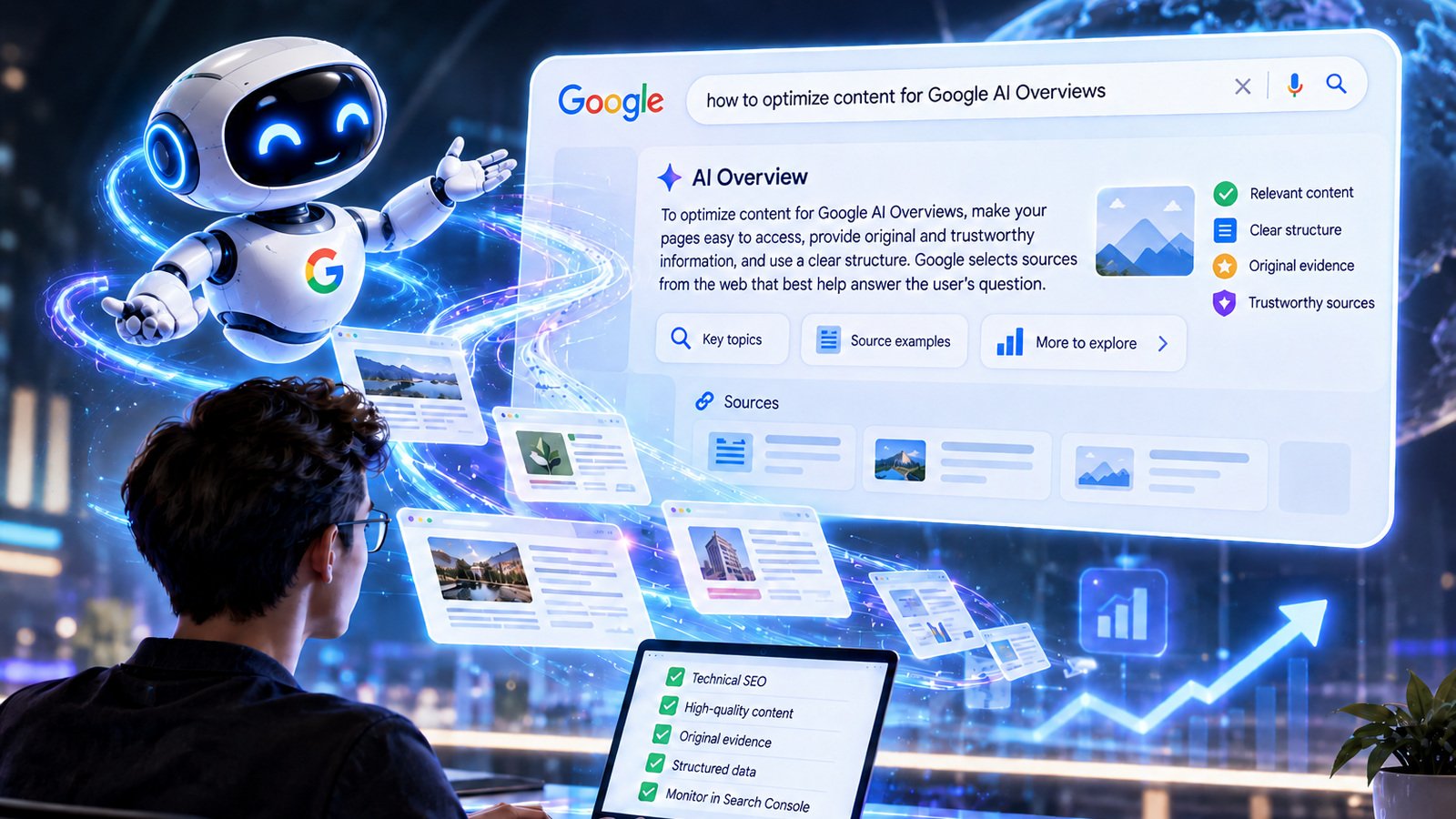
A page may rank well in Google Search yet never be cited in an AI Overview. Before rewriting it for AI, check whether it is eligible to appear at all. Google’s generative search features build on familiar Search systems, not a separate set of mandatory formatting tricks.
To optimize content for Google AI Overviews, establish whether Google can access the page and whether it offers evidence readers can use. You can test technical eligibility, but you cannot guarantee selection as a source. That distinction helps prioritize actual barriers over speculative rewrites.
What Does Google Require to Appear in AI Overviews?
Eligibility doesn’t mean selection. You don’t need to apply for a separate ranking program or publish an AI-formatted copy of every page. Google instead requires an indexed, snippet-eligible page and a site that permits inclusion in its generative AI search features.
According to Google’s AI optimization guidance, a supporting page must be indexed and eligible to appear in Search with a snippet. The site’s Search generative AI setting must also permit inclusion. Those conditions allow consideration, not guaranteed citation; Google still decides which sources to show for each search.
Start in Search Console’s URL Inspection tool. Inspect the indexed canonical URL and any reported indexing issues, then confirm that readers and crawlers can reach the main content. Check the site’s generative AI inclusion setting as well. These are fixable barriers; paragraph length is not a substitute for addressing them.
How Do AI Overviews Find and Cite Web Sources?
Google doesn’t publish a formula for selecting AI Overview sources. Its documentation describes retrieval-augmented generation, which draws relevant pages from the Search index to help ground answers. Query fan-out can also run related searches covering different parts of a question. A useful page might address one supporting issue without echoing the user’s complete query in its title.
Imagine someone researching a heat pump for a small apartment. The broader question could lead to related searches about sizing, installation limits, running costs, and cold-weather efficiency. A detailed explanation of one of those issues may offer more value than another generic buying guide. That’s an illustration of related queries, not a prediction of which pages Google will cite.
AI Overviews and AI Mode can use different models and techniques, so their supporting links may differ. Sources also vary as searches and available information change. From the reader’s perspective, using AI Overviews means opening those links and confirming what they actually support. For publishers, topical relevance matters more than repeating a query word for word.
What Makes Content Worth Citing?
Consider two pages covering the same product. One repeats specifications found across dozens of websites; the other shows how those claims held up in a documented test. Google encourages useful, distinctive content and firsthand perspectives rather than summaries of existing summaries.
A product comparison gains substance when it documents test conditions, measurements, and limitations. A software tutorial can show the interface version, explain platform differences, and describe a failure encountered during setup. Those details help visitors judge the evidence for themselves. That value matters even if an AI Overview never cites the page.
Why Original Evidence Matters More Than Generic Summaries
Suppose five websites repeat a manufacturer’s claim that a battery lasts twelve hours. A sixth page tests the battery, identifies the device configuration, and explains why its result differs. Now readers have a basis for evaluating the claim, not just another repetition of it.
Originality doesn’t require a laboratory. A documented repair, screenshots from the latest tested software release, or a calculation with disclosed assumptions can offer evidence a generic overview lacks. Be clear about what you observed, what you inferred, and which figures came from outside sources. If the underlying product changes, update the evidence rather than presenting an old test as current.
Technical SEO Checks for AI Overview Eligibility
Start with anything that prevents Google from accessing the page. Blocked crawl paths, login requirements, and server errors can hide otherwise excellent content. When similar pages exist at multiple URLs, inspect the indexed canonical and make sure the main explanation appears as readable text. Also test content loaded only after a user interaction, particularly on JavaScript-heavy pages.
Internal links help users and crawlers reach related material. Make their anchors descriptive and connect pages that genuinely extend the topic rather than pointing every article at the same destination. Relevant images, videos, and product details can serve users in ordinary Search as well. None is a shortcut to citations.
Preview controls warrant a separate check. If a page cannot be indexed or shown with a snippet, it cannot qualify as a supporting link in these AI Search features. Privacy and licensing restrictions may be intentional, though. Don’t remove them merely to pursue more exposure.
Check Your Search Generative AI Settings
Open the relevant Search Console property, select Settings, and find Search generative AI. The control includes or excludes site content from supported generative AI features. Inclusion is the default for top-level properties; a child property may inherit its choice from a parent. Confirm which setting applies before treating missing AI visibility as a content problem.
Exclusion applies to AI Overviews, AI Mode, and supported generative AI features in Discover, without removing the site from standard Google Search. Google-Extended addresses certain model-training uses; it does not switch AI Search citations on or off. Changing broad robots rules to solve a Search Console setting issue can create an unrelated indexing problem.
Do Headings, FAQs, and Schema Help With AI Overviews?
Clear headings make a page easier to navigate, and a well-designed table can simplify a complicated comparison. These are sound editorial choices, but Google doesn’t require every section to be a question followed by a tiny answer. There is no prescribed paragraph length or special page structure for AI Overviews.
Structured data still matters when Google supports a relevant Search feature and the markup matches visible content. But it isn’t a special entry pass for AI Overviews. Neither FAQPage nor HowTo markup makes a page more eligible for AI citations. Use schema for its supported purpose, not because an audit tool calls it mandatory for AI.
Keep a FAQ section if readers have recurring questions that the article hasn’t answered clearly. If those questions repeat material already explained in the body, improve the body instead. A readable page matters more than imitating what someone assumes an AI system wants to extract.
AI Overview SEO Tactics That Google Doesn’t Require
Some recommendations sound technical enough to be mandatory but have little support in Google’s documentation. Files such as llms.txt aren’t used by Google Search as a visibility signal, and there is no need to publish a second Markdown copy of every article for AI Overviews. You may maintain such files for other services, but they don’t improve Google Search visibility.
Mechanical content chunking isn’t required either. Google can interpret topics within longer passages, and cutting every explanation into tiny standalone pieces can remove needed context. A troubleshooting procedure may call for connected paragraphs, while a settings checklist works better as short steps. The format should follow the task.
Nor is publishing pages for every slight keyword variation a reliable route to AI citations. Google can understand related meanings without exact phrasing, while overlapping articles may weaken the site’s organization. Be skeptical of services promising guaranteed placements or access to proprietary Google ranking signals. Before making a change, ask which reader problem it solves and what evidence supports it.
How to Track AI Overview Visibility in Search Console
Google rolled out the Generative AI performance report worldwide on August 31, 2026. It measures impressions from links in AI Overviews and AI Mode, beyond conventional Search appearances. The report may not appear for properties with insufficient impressions or those excluded from generative AI features.
Google’s report documentation describes breakdowns by page, country, device, and date, plus text-based and multimodal search filters. Select a consistent date range and identify which canonical URLs account for the largest share of impressions. Compare the trend with the pages you edited and any indexing issues you resolved. Since the report combines AI Overviews and AI Mode, it cannot by itself provide a separate impression total for AI Overviews alone.
Interpret a rise or decline carefully. More impressions might reflect changing search demand, broader coverage, or a different presentation of results rather than the wording of one paragraph. It isn’t a transcript of prompts, nor does it explain why Google selected a particular page. Trends over several weeks are more informative than a spike the day after publication.
A Practical AI Overview SEO Checklist
An audit should end with decisions, not vague scores. First address eligibility checks with observable outcomes, then inspect what the page contributes beyond competing content. If neither reveals a clear problem, monitoring may be more productive than another rewrite. The table pairs each check with a practical next step.
| Check | Where to Look | Useful Next Step |
|---|---|---|
| Indexed and snippet-eligible | Search Console URL Inspection and page directives | Resolve indexing or preview restrictions |
| Included in generative AI Search | Search Console Settings | Confirm inclusion or inherited control |
| Main content accessible | Rendered page and crawl checks | Expose essential text and fix blocked resources |
| Distinctive supporting evidence | Article examples, tests, documentation | Add verified observations or original data |
| Overlapping articles | Site inventory and canonical URLs | Consolidate duplicated search intent |
| Visibility over time | Generative AI performance report | Review impressions by page and date |
An audit isn’t a failure because no citation appears the next morning. A useful result is a page that Google can access, readers can understand, and editors can substantiate. If those conditions are met but visibility remains limited, investigate the wider search landscape before moving headings around again.
AI Overviews provide another way for people to encounter useful sources; they don’t replace the fundamentals of SEO. Make the page accessible, support its claims with evidence, and monitor impressions without treating visibility as a guaranteed reward. The best improvements are useful to readers whether an AI Overview appears or not.